Canada quadrupled its defence contracting. Canadian manufacturers never saw it.
TD Economics' recent report notes that roughly half of Canadian defence procurement flows to foreign suppliers and that the domestic industrial base is weak. This is broadly known, and it is explicitly the premise of the February 2026 Defence Industrial Strategy. TD also observes that capacity utilization in computer and electronic product manufacturing is near the top of its range, attributing this to communications, radar and mission-system components. Decomposing that subsector, the attribution holds for communications but not for radar and navigation.
Given the increase in defence spending, and the stated intent that procurement should strengthen the domestic industrial base, we would expect a response in the Canadian manufacturing sectors that supply defence hardware. While it has been observed that capacity utilization in computer and electronic products (StatCan NAICS 334) has increased, it is near the top of its published range at ~88%.
Capacity utilization isn't published below the three-digit level, so NAICS 334 can't be split directly. Shipments can.
Between 2020 and 2025, shipments across the subsector rose 43%. That growth was not evenly spread:
| Industry | Growth, 2020–2025 |
|---|---|
| Communications equipment (3342) | +0% |
| Semiconductors and components (3344) | +0% |
| Navigational, measuring and control instruments (3345) | +0% |
The third category — containing radar, navigation and military control instruments, the hardware defence demand most directly affects — grew the least of the three. And its growth significantly slowed since 2023, at only 2.5% cumulatively since then, against 18.8% for communications equipment.
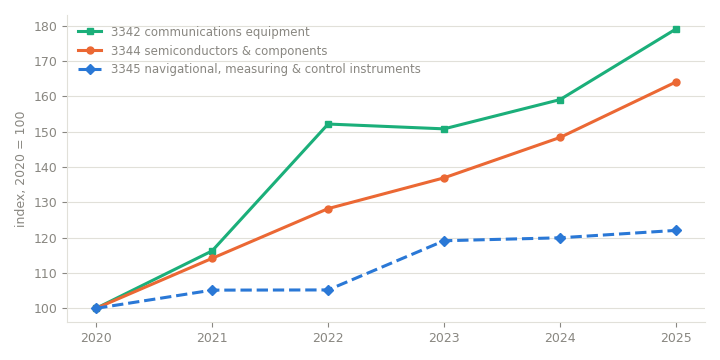
Three readings are plausible. Growth in semiconductors and communications equipment is consistent with dual-use demand, particularly data-centre and network buildout, which this data captures regardless of defence, though some of the communications growth may itself be defence-related. It is also possible that sensing capability increasingly ships as components to integrators rather than as finished instruments, which would move it from 3345 into 3344. Most importantly, these are shipments to all customers, and domestic defence procurement is a small share of output in all three industries. The contract and shipments data point the same way, but they are independent observations rather than cause and effect.
Additionally, further assessing where defence spending was directed, TD's report uses the widely reported figure that roughly half of defence spending flows abroad. That figure comes from a survey in which firms self-report supply-chain origin. However, federal contract records allow examination of awards classified by vendor domicile. In 2023, DND awarded $7.94bn in goods contracts, of which only $1.96bn went to Canadian-domiciled vendors, roughly $6bn to foreign firms. Canadian subsidiaries of foreign firms count as Canadian-domiciled, so $1.96bn is an upper bound on what reached principally Canadian firms.
Important to note is that the increase did not primarily go abroad. In 2024, 84% of DND award value went to Canadian-domiciled vendors, largely because the single largest award was a domestic services contract for pilot training rather than a purchase of manufactured goods. Goods were 15.2% of 2024 awards and 23.7% of 2025 awards. Awards for goods to Canadian-domiciled vendors were flat at $3.96bn in 2020 and $3.91bn in 2025, while total awards rose 4.4× between 2021 and 2024. Their share of the total fell from 56% to 12% at its low point in 2024.
However, award values are commitments, not immediate spending. A 25-year contract books in full in its signing year. These figures should be read with care, as awards are highly concentrated. Three contracts account for about 24% of all DND contract value since 2019. SkyAlyne 12.2% from a single award, Irving Shipbuilding 11.7% from two. Year-on-year growth rates from this file should not be read as changes in the underlying rate of contracting.
It is also too early to read this as a failure of procurement reform. The largest commitments are recent, and industrial capacity responds over long time horizons. What the data shows is that the transmission from defence spending to domestic manufacturing has not yet happened.
Taken together, the two datasets describe the same gap from different directions. Defence contracting has risen sharply, but the awards that could support Canadian manufacturing have not. Additionally, the Canadian industry best positioned to supply defence sensing hardware has grown more slowly than its counterparts in a subsector that has expanded 43%. The second point is significant because it rules out the simpler explanation that Canadian electronics manufacturing is weak in general. Communications equipment grew 79% over the same period, and semiconductors 64%. It does not appear that a lack of manufacturing capability is holding back the defence-relevant segment. The question is more likely what is being bought, in what form, and from whom.
The Defence Industrial Strategy is explicitly designed to change this. Its Build-Partner-Buy framework, its ten designated sovereign capabilities, and the reform of the Industrial and Technological Benefits policy all seek to minimize the gap between money committed and realized domestic industrial output. The figures here are a reasonable baseline to measure success by. If the strategy is doing what it claims, awards for Canadian-made goods and shipments of navigational and control instruments should both begin to move. Neither has yet.
Sources: Proactive Publication – Contracts (Treasury Board of Canada Secretariat); Statistics Canada tables 16-10-0047-01 and 16-10-0012-01. Contract figures are deduplicated on procurement_id and measured as new money committed. Full methodology.