Mechanisms of Corruption: How Corruption Can Be Optimal on Margins, and How It Becomes Broadly Destructive
Corrupt systems are fundamentally alike in several key characteristics that enable certain agents to consistently navigate these systems to their advantage. To illustrate this point, we can trace and compare corrupt systems to meritocratic systems. I will use a few examples to make this idea more concrete.
Example: University Acceptances
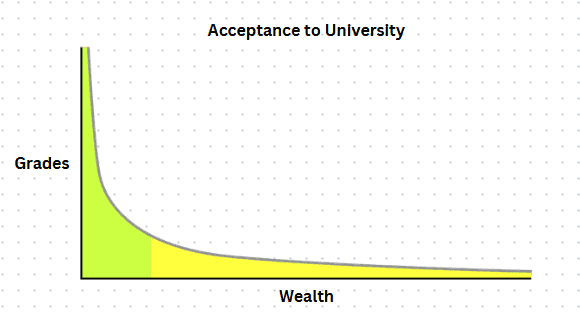
If two students are applying to a university with the same merit to each application, and one student is from a prominent family that may donate a large sum to the university, then the university may accept the student with the prospect of donation, and make all students of the university better off, by allocating the additional funds to school resources. The university, by discriminating against the student without the prospect of donation, identifies some value outside of academic merit in the donation, which indicates they would likely accept a very slightly worse student if they had the prospect of donation. Although practices like this are strictly regulated against, when the quality of a student's application is subjective, it may be fairly easy to continue discriminating within the system.
This example illustrates that actions on the margin of otherwise efficient meritocratic systems create opportunities for corrupt processes to emerge. These processes on the margin have no negative effects on the system's outcomes initially, and can benefit members of the system — in this case, allowing the university to spend more on every student — but in aggregate, compound and produce inefficient outcomes. The problem is that human beings are unable to discern at what point giving acceptance based on wealth, or using any criteria outside the system to select, changes the acceptance process from a meritocratic one to a corrupt one. There is always a tipping point, where either an applicant is just very slightly too unqualified to be accepted, or one too many high-potential donor prospects is accepted.
The issue is that humans are bad at operating on the margin. It is really hard to identify where the tradeoff between grades and wealth is optimized. The reason is that it is good for an organization to, for example, select wealthy people up to a point, so this behaviour works for some period of time. People, in trying to act consistently with what has worked in the past, continue to select wealthy people after the optimal number of them has been reached. It usually, however, takes a significant amount of negative feedback to realize the approach is broken, and to undo the initial positive reinforcement.
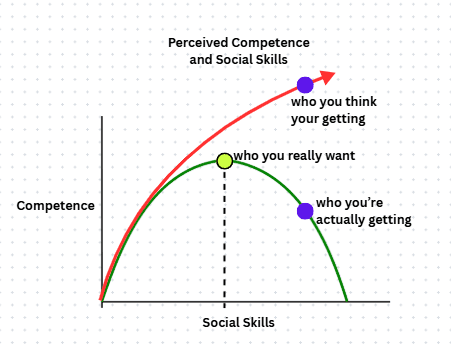
Perceived vs. Misperceived Competence with Social Skills
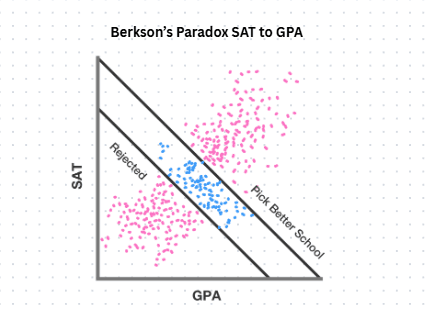
There is an inevitable trade-off between social skills and ability, as candidates who have both exceptionally high social skills and ability will get hired for a better job, while those too deficient in either won't get hired at all. (Interestingly, trade-offs like this can appear between any two characteristics in selection processes — the phenomenon is called Berkson's Paradox.)
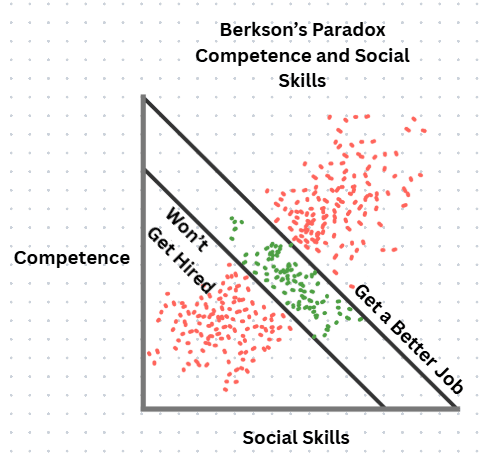
Individuals who succeed in corrupt systems are better at identifying where there are opportunities to take advantageous action outside of the primary system. Often, what actions are within or outside the system are not entirely clear. When applying to a job, an applicant who actively seeks out hiring managers and makes an effort to connect with them puts themselves at an advantage, but isn't necessarily operating outside of the system. But if that agent overly relies on familial connection or gives gifts to a hiring manager, they are considered to have acted outside of the spirit of the hiring process. What is important to recognize is that no matter how regulated a system is, there will be small windows on the boundary of what is acceptable — i.e., what someone can get away with — that allow for distortions in the system.
The challenge with regulating corrupt systems is that deviating from the system is initially harmless and selects for positive traits in a candidate, like niceties, trust, and relationship-building, or small financial improvements. However, systems that allow niceties, trust, and relationships leave themselves more vulnerable to corrupt takeover. The option to invest in a relationship by taking someone on a nice dinner becomes an obligation rather than a genuine gesture, so becomes normalized, and the costs of relationship-building activities continually escalate and increasingly distort the efficiency of a system. Social hiring is not sufficient to lead to corruption, but all corruption can be traced to decisions that slightly diverge from an intended selection process and that are not corrected for.
Conversely, it is also costly to go to the other extreme and regulate away too many human elements — it creates the same problem, skewed to the other direction. The solution lies in recognizing where candidates are on the trade-off curve. Notice when a candidate seems to have an outlier level of social skills and competence, and reflect on whether you are on the perceived-competence curve and making a trade-off, and if the rockstar candidate would not be at a better job.